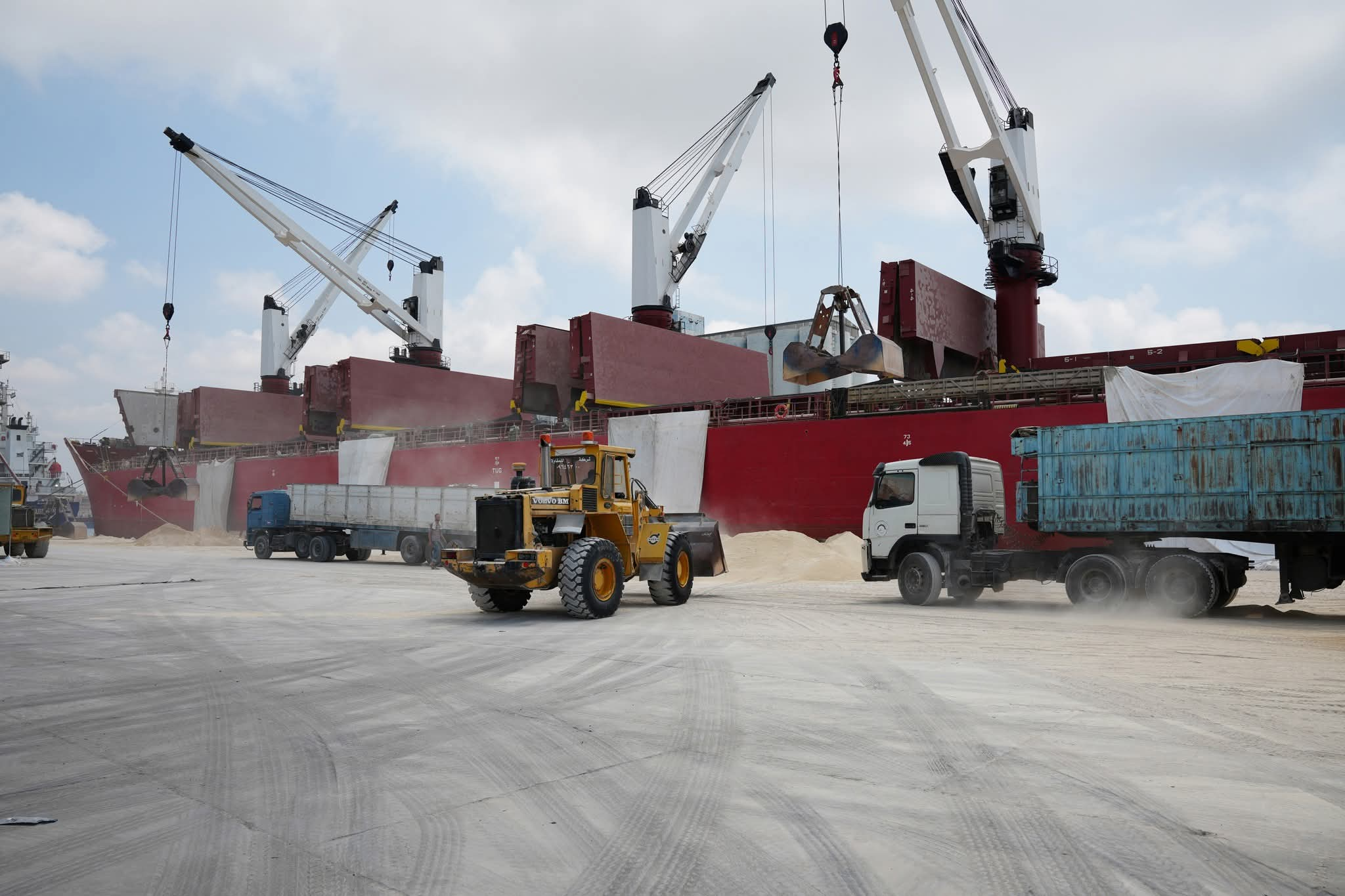
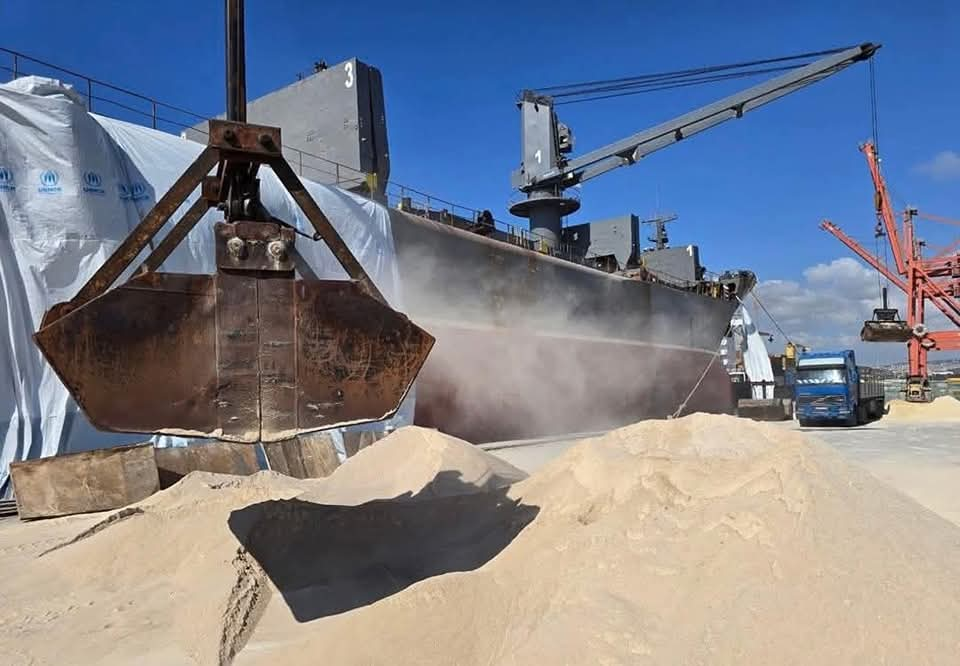
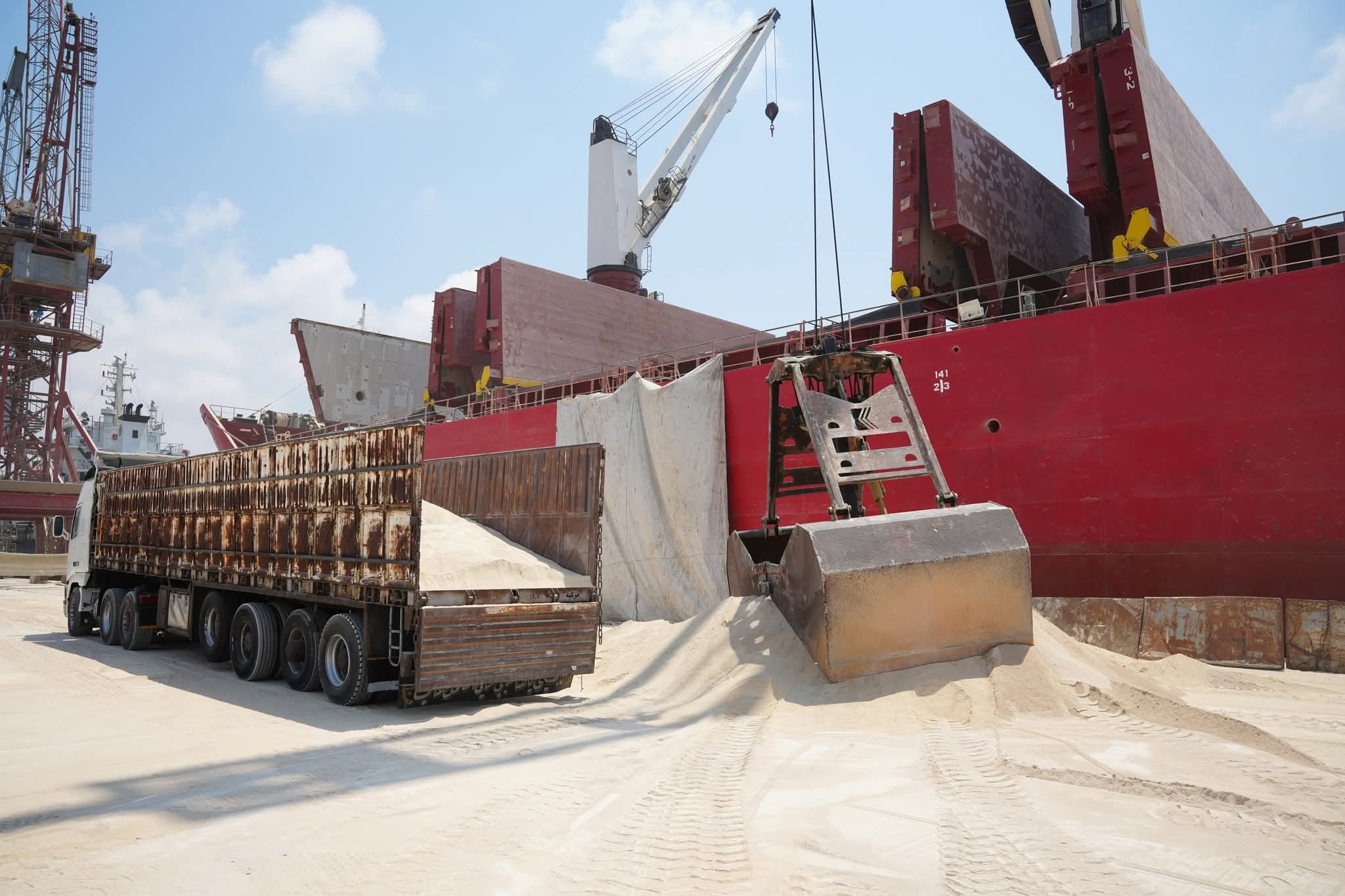
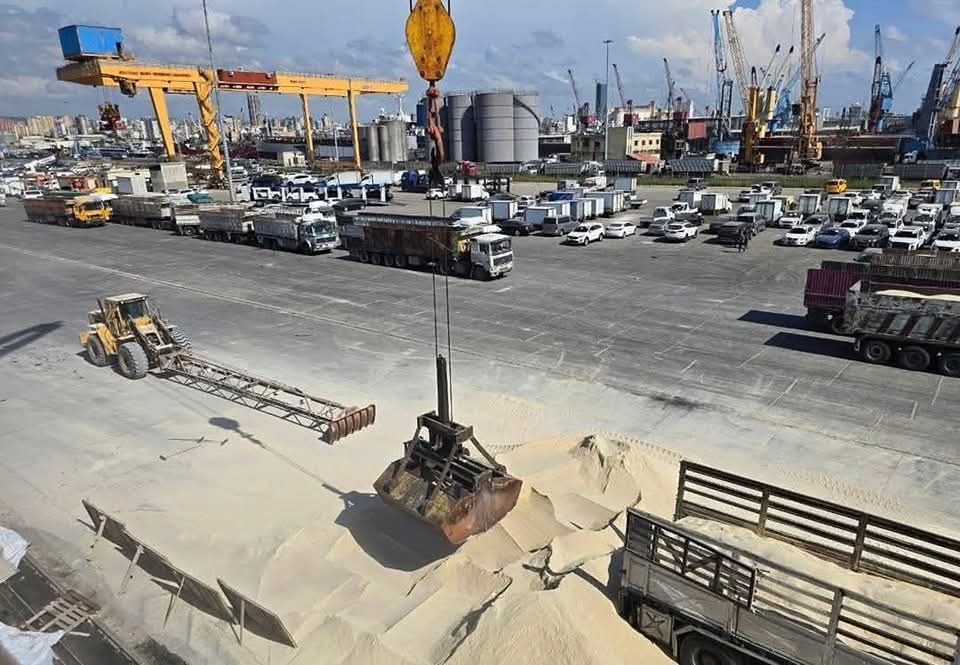
A successful bulk terminal depends on every stage working together: vessel access, unloading, transfer, storage and dispatch.
InVenture brings commercial and technical expertise together to support terminal design and implementation. We consider the cargo, the site and the intended operation as one system.
01Marine access
What the berth can actually receive.
Two sections through the same trade, drawn to scale. Alongside, the depth you
have decides the class you can work and the parcel that follows. When the water
is not there, the cargo still moves — at anchorage, into lighters, through a
floating crane, and at a price paid in cycle time. Change the vessel, the depth
and the tide, and the plate redraws.
Vessel—
Draft—
Under-keel—
Parcel—
Freeboard—
Drawn to a single scale, horizontal and vertical alike — no exaggeration.
Vessel particulars are indicative class figures for planning, not any
particular ship, and the tidal levels are an example regime until survey
establishes yours. Real work starts from the chart datum on your own survey,
the controlling depth along the approach — usually shallower than the berth —
and the squat and motion allowance your under-keel policy is written against.
05Terminal advisory
From the roads to the berth.
Throughput is decided long before the cargo arrives. The depth carried
along the approach and alongside sets the vessel you can take; the vessel
sets the parcel; the parcel sets what the terminal can move in a year.
Get that chain wrong at design stage and no amount of equipment fixes it.
Depth alongsideVessel classIndicative DWT
to 10 mHandysize10,000 – 40,000
11 – 12.5 mSupramax / Ultramax50,000 – 65,000
13 – 14.5 mPanamax / Kamsarmax70,000 – 85,000
17 m and overCapesize100,000 +
Indicative only. Real figures come from survey: declared depth against chart
datum, tidal window, under-keel clearance, and the controlling depth along
the approach — which is often shallower than the berth itself.
Approach and anchorage
The controlling depth between the roads and the berth, tidal windows,
and how long a vessel waits before it can come alongside.
Berth and draft
Depth alongside against chart datum, under-keel clearance, and the
largest vessel the berth can actually work rather than nominally accept.
Handling and throughput
Cranes, grabs, conveyors and sheds sized to the grade — and the annual
tonnage that combination genuinely supports.
Design to implementation
Carrying a terminal from layout and equipment selection through to a
facility that runs at the rate it was drawn for.
06Berth capacity
Occupancy is not utilisation.
A berth run at 90% looks like an asset being used properly. It is usually a
queue. Waiting time does not rise with occupancy in a straight line — it
accelerates, and it accelerates hardest where there is only one berth. Move
the sliders and watch where the curve leaves the floor.
Expected wait—
In service times—
Calls per year—
Annual throughput—
Queue risk—
Screening tool, not a design basis. Computed live from the Erlang-C
formula for an M/M/n queue — random arrivals, exponentially distributed time
alongside, first come first served, steady state, all berths able to work all
calls. Our implementation reproduces the published
UNCTAD queueing table at all twelve points we test it against, including a
control that fails deliberately if the check itself stops working. Real arrivals are rarely Poisson: a
contract trade with nominated arrival windows queues considerably less than
this curve shows, spot and seasonal trades rather more. It models none of
what actually stops a berth — weather, tidal window, draft restriction,
cargo changeover, equipment failure, stockyard saturation, working-hour
rules. Use it to see the shape of the risk, not to size a facility.
Diagnostic
Where the occupied hours actually go.
Occupancy tells you a ship was there. It does not say whether anything was
being done. Split the occupied time four ways and the answer usually changes
the investment case — because the first reaction to a congested berth is to
build another one, and the cause is frequently that the berth already there
is worked for a third of the time it is occupied.
15%
25%
35%
25%
Vacant. No ship. The only band that new berths add to.
Occupied, not working. Alongside, nothing moving — shift gaps, awaiting documents, awaiting a decision.
Occupied and working. The only productive band. Here, a third of the time.
Occupied, not workable. Weather, breakdown, no gang, berth used for something that is not cargo.
An illustrative case at 85% overall occupancy, not a specific facility. Recover
the two unproductive bands and the same quay carries the same tonnage with the
queue collapsing — a far cheaper answer than a new berth, and the one that is
routinely skipped because occupancy alone never showed the problem. Note also
that the recording interval alone moves the headline: tick a box once a day and
a week that measured 70% by the hour reports as 90%.
Output vs productivity
More tonnes an hour, more cost a tonne.
The two are not the same measurement and they do not move together. You can
raise output at any time by adding people and machines. Whether that was worth
doing is a different sum, and it is the one that decides an equipment case.
Illustrative comparison of present operation against a heavier-resourced alternative
Illustrative berth operation
Present
Heavier crewing
Workers per gang
20
26
Cranes per gang
1.0
1.5
Gangs working the ship
2
3
Output per gang-hour (t)
20
25
Output per ship-hour (t)
40
75
Crane cost per ship-hour
$200
$450
Labour cost per ship-hour
$240
$468
Handling cost per tonne
$11.00
$12.24
Output per ship-hour rises by 88%; the cost of handling a tonne rises by 11%.
The heavier option only pays if the time saved is genuinely realised somewhere
— and it evaporates the moment the vessel that finished early then waits on a
pilot, a tide or a berth. That is why we model the terminal as one system
rather than optimising the quay in isolation. Illustrative figures at
round-number rates, shown for the arithmetic, not as market prices.
07Stockyard
The yard is the terminal.
Quay equipment is chosen from a catalogue. The stockyard is the decision you
cannot revisit: layout fixes capacity, blending ability and which grades you
can hold apart, for the life of the site. A yard with no room to keep two
qualities separate cannot buy the cheaper cargo and blend it — the commercial
option is lost at the drawing stage, years before anyone notices.
Longitudinal bed
Suits long sites and very large tonnages, into the millions. Capacity is
extended cheaply later by lengthening the track and the conveyors, and
long-term and short-term piles can sit side by side.
Extendable · high capacity · longer civils
Circular bed
Suits squarer sites to roughly a hundred thousand tonnes. Lower capital
and operating cost, but capacity is fixed once built and the shorter layer
length means input lots must be smaller to blend properly.
Compact · fixed capacity · small lots
Cone shell
Stacked continuously on one axis. Simple and cheap; poor blending, and the
coarse fraction rolls to the toe.
Segregation high · blending poor
Chevron
Roof-shaped layers from one discharge point on the centreline; reclaimed
from the end, across every layer. Good blending, still segregates by size.
One discharge point · end reclaim
Windrow
Rows laid by a slewing boom with several discharge points. Costlier stacker;
segregation minimised, which is what a wide size range needs.
Multi-point · least segregation
Chevcon
Cone-and-chevron on a circular bed around a central column: stacking the
leading face while reclaiming blended material behind it. Continuous.
Circular · stack and reclaim together
Blending improves with the number of layers, and every linear bed has the same
known weakness: the end cones do not contain all the layers, so the first and
last of a pile run off-grade unless they are recycled. That is predictable at
design stage and can be quantified in advance — which is the difference between
a grade excursion you planned for and a claim.
Reclaimer type is a blending decision
Side-working bucket wheels are selective — they will take a hot or
off-spec area out of a pile — and reach very high rates, but they never see
the whole cross-section, so they blend less well. Bridge and portal
scrapers work the full face and blend excellently; they cannot step over a
neighbouring pile. Choose for the property you actually need, then lay the
yard out around that machine.
Selectivity and blending pull opposite ways.
Geometry is a dust control
Free surface is what the wind erodes. One heap holding what two held cuts
exposed surface by about a quarter; the long axis wants to lie along the
prevailing wind; an upwind retaining wall or embankment removes more
surface still, and windbreak netting has been measured at roughly halving
wind velocity. Each of those has a price — walls restrict access, netting
has a short life and traps birds, and moving the pile shape moves your
capacity.
Shape the pile before you buy the sprays.
Where the two rules fight
Minimising wind-exposed surface wants steep, tall, walled piles.
Controlling self-heating in a reactive material wants shallow slopes, dense
compaction and no stagnant material against a wall. Both are correct and
they cannot both be satisfied. Where a cargo can heat, the shallow answer
wins and the lost capacity is designed for — not discovered later.
Safety-critical direction wins; capacity is the price.
A live pile cannot be instrumented like a stored one
Grids of buried thermocouples suit a strategic pile, not one being stacked
and reclaimed daily — and early hot spots are local enough to sit between
the probes. Working yards rely on rapid turnover, compaction discipline,
gas indication and, above all, on not stacking incompatible material
together in the first place. Detection is not a substitute for layout.
The monitoring plan starts at the layout.
Discharge to road, worked off the apron rather than a conveyor: the heap is the buffer, and the truck fleet sets the rate.
Equipment landscape
Who builds the machines — and who supports them now.
Terminal plant comes from four separate supplier groups with different economics.
The nameplate on a thirty-year-old machine is often not the company that can
support it today — several of the great European lineages have changed hands.
A rated capacity in a brochure is a claim. What a terminal gets across a
full vessel depends on hold geometry, clean-up and the plan agreed with the ship.
08Method
The InVenture terminal diagnostic.
Every terminal has one constraint that is actually binding, and it is rarely
the one being discussed. Our engagement is built to find it, put a number on
it, and say what changes — in that order, and in writing.
01
Cargo definition
What actually crosses the quay, by grade and not by trade name: size
distribution, moisture, density, dust class, abrasion, corrosion, heating
behaviour, and how that mix varies through a year.
Output — cargo basis with the handling implications stated
02
Marine access
Controlling depth on the approach against chart datum, tidal window,
under-keel clearance, and the largest parcel the berth can work rather
than nominally accept.
Output — admissible vessel and parcel envelope
03
Berth time analysis
Occupancy split into vacant, occupied-not-working, occupied-and-working and
occupied-not-workable, with queueing exposure modelled against it. This is
where a proposed new berth usually turns into a shift pattern.
Rated against achieved capacity for each leg — ship-to-shore, transfer,
stacking, storage, reclaim, delivery out — to find the leg that is setting
the terminal's real rate.
Output — bottleneck identified and quantified
05
Yard and environment
Storage capacity against the trade's stock cycle, blending requirement,
segregation of grades, dust and run-off control, and the conflicts between
those objectives resolved explicitly rather than averaged.
Output — yard layout and control strategy
06
Throughput case and route
The annual tonnage the facility genuinely supports today, the tonnage each
intervention buys, what each costs, and the order to do them in — including
the interventions that cost nothing but a decision.
Output — staged plan, costed, with the capacity each stage releases
07
Implementation
Specification, procurement support and site presence through commissioning,
so that the facility is proved against the throughput it was designed to —
not handed over against a drawing.
Output — a terminal running at the rate it was drawn for
Engagements are scoped to the facility. Nothing on this page is a design basis,
a compliance opinion or a substitute for site-specific engineering, permitting
and statutory sign-off.
09Hailing
Get in touch.
For a cargo enquiry, tell us the grade, the tonnage and where it has to be
delivered. For a terminal, the useful first message is shorter than most people
expect: the depth you have, the cargo you handle and the tonnage you are trying
to reach. That is enough to say whether the constraint is the water, the quay
or the yard — and we will say which before anything is scoped.